
Beneath the Soil
Tracing Ancestral Memory, Genetics, and the Limits of Science

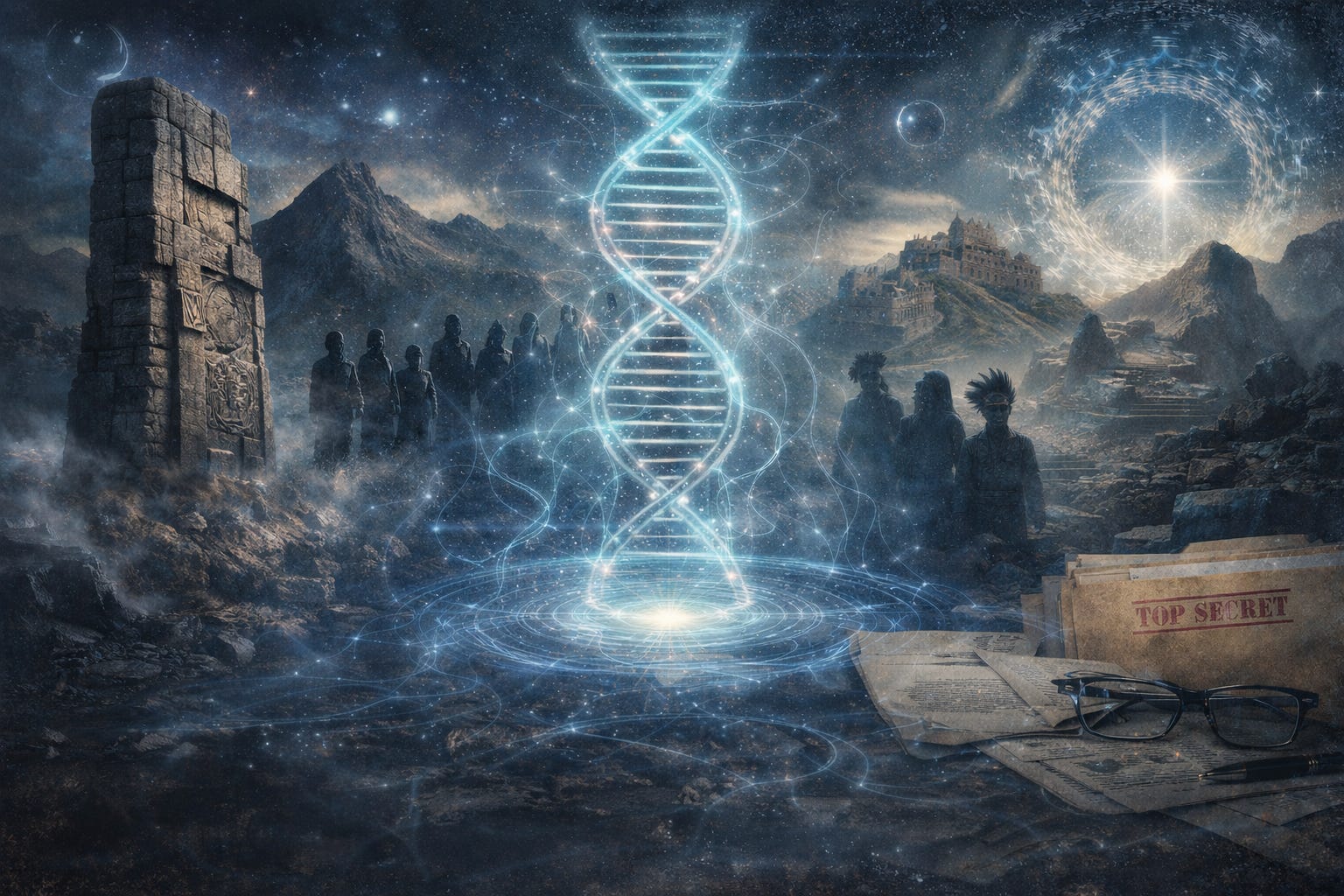
There is a resonance beneath the soil of the Americas; a truth not yet mapped by science, but reported repeatedly by those who carry ancestral memory in their bodies. It appears inside of recognition and recall. For centuries, this memory grid has surfaced in dreams, oral histories, and patterns of kinship that defy tidy explanation.
Investigating this resonance requires crossing disciplinary borders. Genetics alone cannot hold it. Anthropology hints at it. Neuroscience circles it. Indigenous knowledge systems tell the ancient, oral stories of it. What emerges is not a single answer, but a convergence; one that suggests the story of human origin, migration, and consciousness is a system of several parts.
A Genetic Thread Across the Americas
Modern population genetics confirms that Indigenous peoples of the Americas descend primarily from ancient migrations across Beringia1, supported by mitochondrial DNA (mtDNA), Y-chromosome markers, and autosomal data. Yet within this broad consensus, researchers continue to encounter outlier haplogroups and unexpected genetic signatures that do not fit neatly into dominant models2.
Studies of Indigenous populations in South America, particularly Andean communities, show some of the highest levels of genetic continuity in the hemisphere.3 While no population is genetically “pure,” Andean highland groups demonstrate remarkably strong lineage persistence despite centuries of colonial disruption (Reich et al., Nature, 2012; Skoglund & Reich, 2016). This continuity makes them invaluable to genetic research, as fewer admixture events allow deeper visibility into ancient inheritance.
Across North America, certain Indigenous groups display rare or disputed mitochondrial haplogroups, including instances of haplogroup X and debated findings involving haplogroup T. While mainstream genetics attributes these to ancient Eurasian lineages entering during early migrations, some researchers have noted temporal and geographic inconsistencies that remain unresolved (Malhi et al., PNAS; Kemp & Schurr, 2010).
These anomalies are not evidence of extraterrestrial origin; but they are indicators that our current migration models may be incomplete.
Stone, Altitude, and Frequency
Archaeology adds another layer. The megalithic complexes of the Andes, Sacsayhuamán, Ollantaytambo, Machu Picchu, continue to challenge engineers. The precision of stone fitting, seismic resistance, and acoustic properties of these sites suggest an advanced understanding of resonance, vibration, and material science long before modern tools existed.
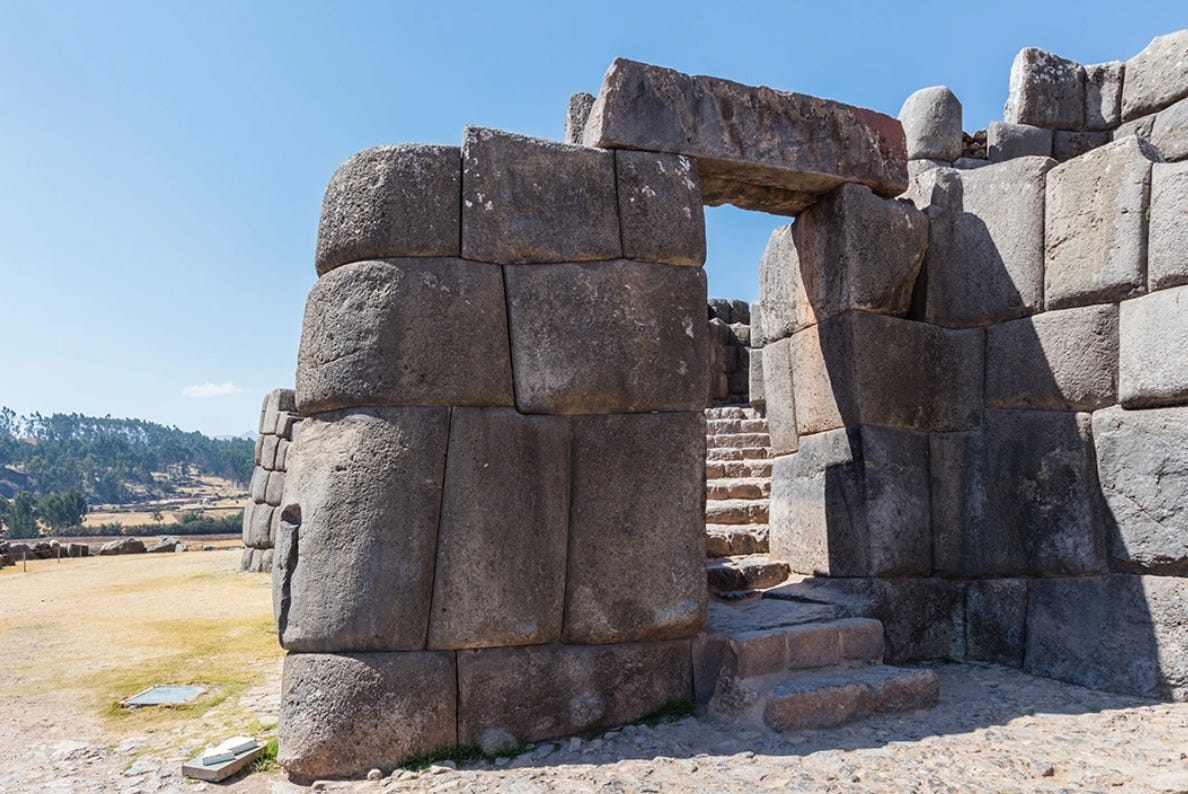
Independent studies have shown that certain megalithic sites produce measurable acoustic amplification and vibrational effects, particularly at low frequencies known to affect human cognition and emotional states (Debertolis & Bisconti, Journal of Archaeological Science, 2013). Quartz-rich stone, prevalent in Andean construction, is now known to exhibit piezoelectric properties; the ability to generate electrical charge under pressure.
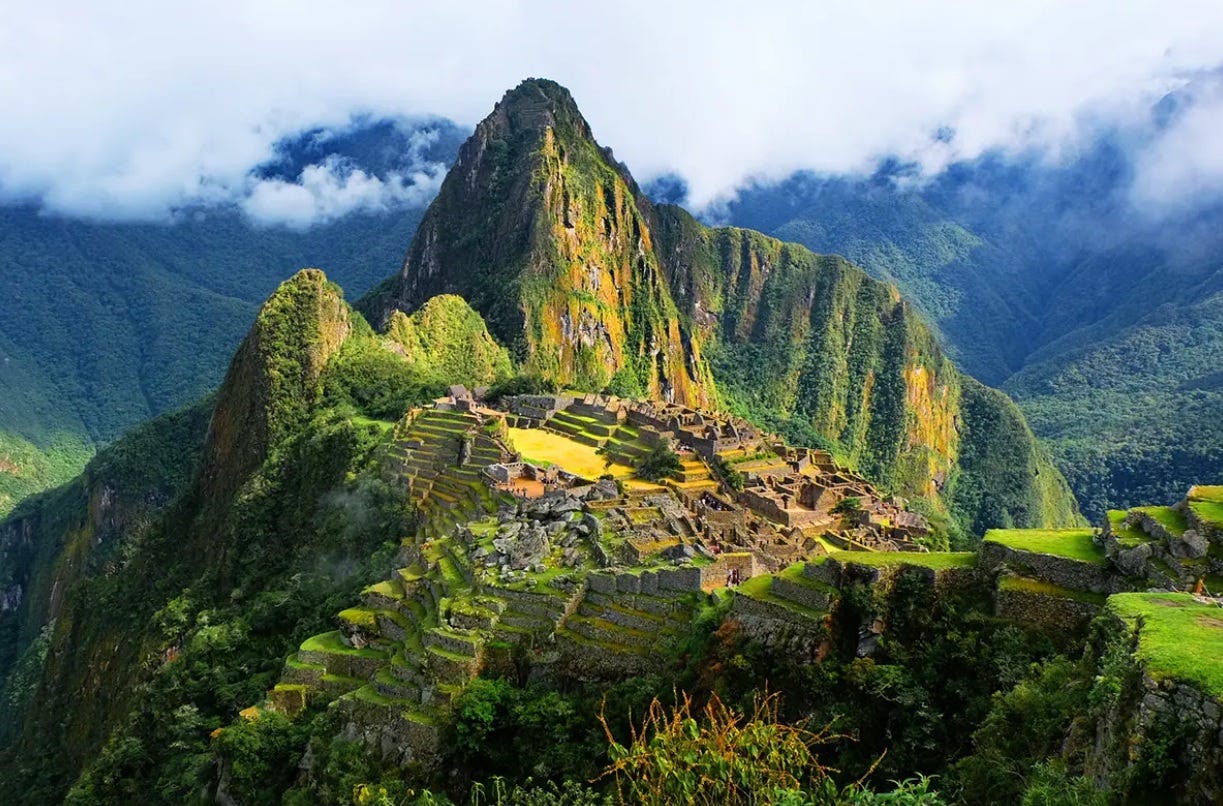
📷Machu Picchu: The genius of Andean engineering
To Indigenous cosmologies, these sites were never “dead structures.” They were alive. Receivers. Anchors between worlds.
Oral Tradition as Data
Western science often treats oral history as metaphor. Increasingly, researchers are learning this is a mistake.
Indigenous narratives from the Andes, Appalachia, and the Pacific Northwest repeatedly describe:
Star ancestors
Beings emerging from beneath the Earth
Tunnel systems linking sacred sites
Knowledge transmitted through dreams and altered states
Anthropologists now recognize that oral traditions can preserve accurate geological and astronomical data for thousands of years (Nunn & Reid, Geoscience Letters, 2016). When similar motifs recur across distant cultures, they warrant examination; not dismissal.
These traditions do not describe conquest. They describe instruction.
Consciousness, Trauma, and Ancestral Memory
Neuroscience offers another bridge. Research into epigenetics shows that trauma, stress, and environmental pressures can alter gene expression across generations (Yehuda et al., Biological Psychiatry, 2016). Memory, it turns out, is not confined to the brain.
Individuals reporting heightened intuition, vivid symbolic dreaming, and altered perception are often found in populations with strong ancestral continuity. While such experiences are frequently pathologized, emerging studies on non-ordinary states of consciousness suggest these may represent adaptive sensitivity rather than dysfunction (Lutz et al., Trends in Cognitive Sciences).
Some researchers have begun exploring whether consciousness itself may be non-local, a hypothesis investigated in quantum biology, parapsychology, and theoretical neuroscience. While controversial, these fields are no longer fringe. They are funded, peer-reviewed, and quietly expanding.
→ read this article on the history of consciousness studies
The Hybrid Hypothesis
Within this context, the Centarfican framework functions not as belief, but as interpretive hypothesis; a model attempting to integrate genetics, archaeology, consciousness studies, and lived experience.
In this model:
DNA is not merely biological, but informational
Consciousness may braid from multiple sources
Certain lineages act as carriers, not rulers
Awakening occurs when environmental and psychological thresholds are met
Science does not yet possess the instruments to measure such claims directly. But absence of measurement is not absence of phenomenon. History is filled with truths that preceded their tools.
Soul Fragmentation and Psychological Reality
What some traditions may describe as soul loss (or wandering), modern psychology recognizes as dissociation, a survival response to trauma. Studies show that individuals with heightened sensitivity are more susceptible to dissociative states under stress (van der Kolk, The Body Keeps the Score).
Whether framed spiritually or neurologically, the phenomenon is real. Healing practices; grounding, ritual, solitude, somatic integration, are now being reintroduced into trauma therapy, often borrowing directly from ancient knowledge systems once dismissed as superstition.
Where This Leaves Us
This limited investigation concludes without certainty, but with responsibility.
The evidence suggests:
Human history is not fully mapped
Indigenous knowledge preserves data modern science is only beginning to decode
Consciousness may be far less local, and far older, than assumed
Whether one can identify the underlying intelligence or not, the signs are consistent: something ancient is re-emerging through the descendants who were meant to carry it forward.
This is not mythology.
It is not dogma.
It is inquiry at the peripheral of what we can measure.
And the hybrids are moving.
A Skeptic’s Lens: Where Evidence Ends and Interpretation Begins
Responsible inquiry demands restraint. While the patterns explored in this investigation are compelling, it is essential to distinguish between documented evidence, open scientific questions, and interpretive frameworks that extend beyond current verification.
Modern genetics, for example, does not support the existence of non-human or extraterrestrial DNA within populations as defined by current sequencing standards. Mitochondrial haplogroups such as X or T, while uncommon in the Americas, are generally explained by early Eurasian migrations, population bottlenecks, or statistical outliers rather than external intervention. Claims of “hybrid DNA” therefore remain hypothetical and symbolic, not empirically demonstrated.
Speculatively hybrid identity may currently stem more from intuitive feeling than physical science, but that doesn’t rule out the possibility of science meeting itself in the process.
→ could the term “hybrid” be just an identifier for a certain archetype of human?
Similarly, archaeological mysteries surrounding megalithic construction, acoustic resonance, or material sophistication do not require non-human explanation. Human ingenuity, lost technologies, and cultural knowledge systems, especially those erased or dismissed by colonial frameworks, can account for many anomalies without invoking external intelligence.
Reports of telepathy, ancestral memory, or multidimensional perception occupy a contested space between neuroscience, psychology, and consciousness studies. While research into epigenetics and trauma inheritance confirms that memory and stress responses can echo across generations, no consensus exists that supports non-local consciousness or interdimensional awareness as measurable phenomena. Such experiences may arise from altered neural states, dissociation, or symbolic cognition rather than external contact.
That said, skepticism does not require dismissal.
History repeatedly shows that scientific consensus evolves. Continental drift, epigenetics, neuroplasticity, and even the existence of microbes were once ridiculed ideas. What separates rigorous inquiry from belief is not certainty, but methods.
The value of this investigation lies not in asserting conclusions, but in identifying patterns science has not yet fully explained:
Why certain oral traditions preserve remarkably consistent cosmological narratives across continents
Why some megalithic sites demonstrate measurable acoustic and vibrational effects with psychological impact
Why specific populations report parallel dream symbolism, intuitive perception, and ancestral recall
At present, these observations invite further research; not belief, and not rejection. More humans could learn by mastering being at peace inside unknowns.
Current frameworks should therefore be understood as a narrative hypothesis, not a scientific claim. It offers one way of organizing data, lived experience, and cultural memory into a coherent story, while acknowledging that future discoveries may revise or replace it entirely.
Skepticism, at its best, does not close the door.
It keeps it unlocked.
What Next?
What remains, after genetics is parsed and archaeology measured, after consciousness is debated and skepticism applied, is not a final answer but a widening perimeter. The deeper one looks, the more the mysteries of the known begin to emerge. Migration models grow more complex. Oral histories gain credibility as data storage systems. Trauma research reveals memory embedded in tissue and gene expression. Acoustic science confirms that stone can shape cognition. None of these discoveries prove a hidden civilization or hybrid lineage. But together, they illuminate a single truth: the human story is larger than the version we inherited.
Perhaps the most responsible conclusion is this: the boundary between myth and data is not fixed; it shifts with instrumentation, interpretation, and cultural humility. What one generation calls superstition, another measures with electrodes. What one era dismisses, the next funds and publishes. The convergence described here may not be a literal merging of realms beneath the Earth, but it may represent something just as profound; the merging of disciplines, the reintegration of Indigenous knowledge with laboratory science, the recognition that consciousness itself may be participatory rather than isolated. In that sense, the “Underverse” may be not just a place, but also a more layered understanding long buried under colonial simplifications and technological arrogance.
Inquiry does not weaken when it approaches the unknown; it strengthens. The patterns outlined in this investigation demand neither belief nor denial, but sustained attention. If something ancient is indeed re-emerging—through memory, through research, through the descendants who carry continuity in their blood; it will not require spectacle to announce itself. It will surface the way most truths do: gradually, through convergence. Not with thunder, but with recognition, respect, mindfulness and understanding.
©️ Centarficus | Centarficus.com
Centarficus © 2015 by Vennie Kocsis is licensed under CC BY-NC-ND 4.0
Selected Research & Reading (for readers)
Reich et al., Nature (2012) – Reconstructing Native American population history
Skoglund & Reich (2016) – A genomic view of the peopling of the Americas
Malhi et al., PNAS – Mitochondrial DNA and Indigenous migration
Debertolis & Bisconti (2013) – Acoustic properties of ancient stone sites
Nunn & Reid (2016) – Indigenous oral traditions as geoscientific data
