
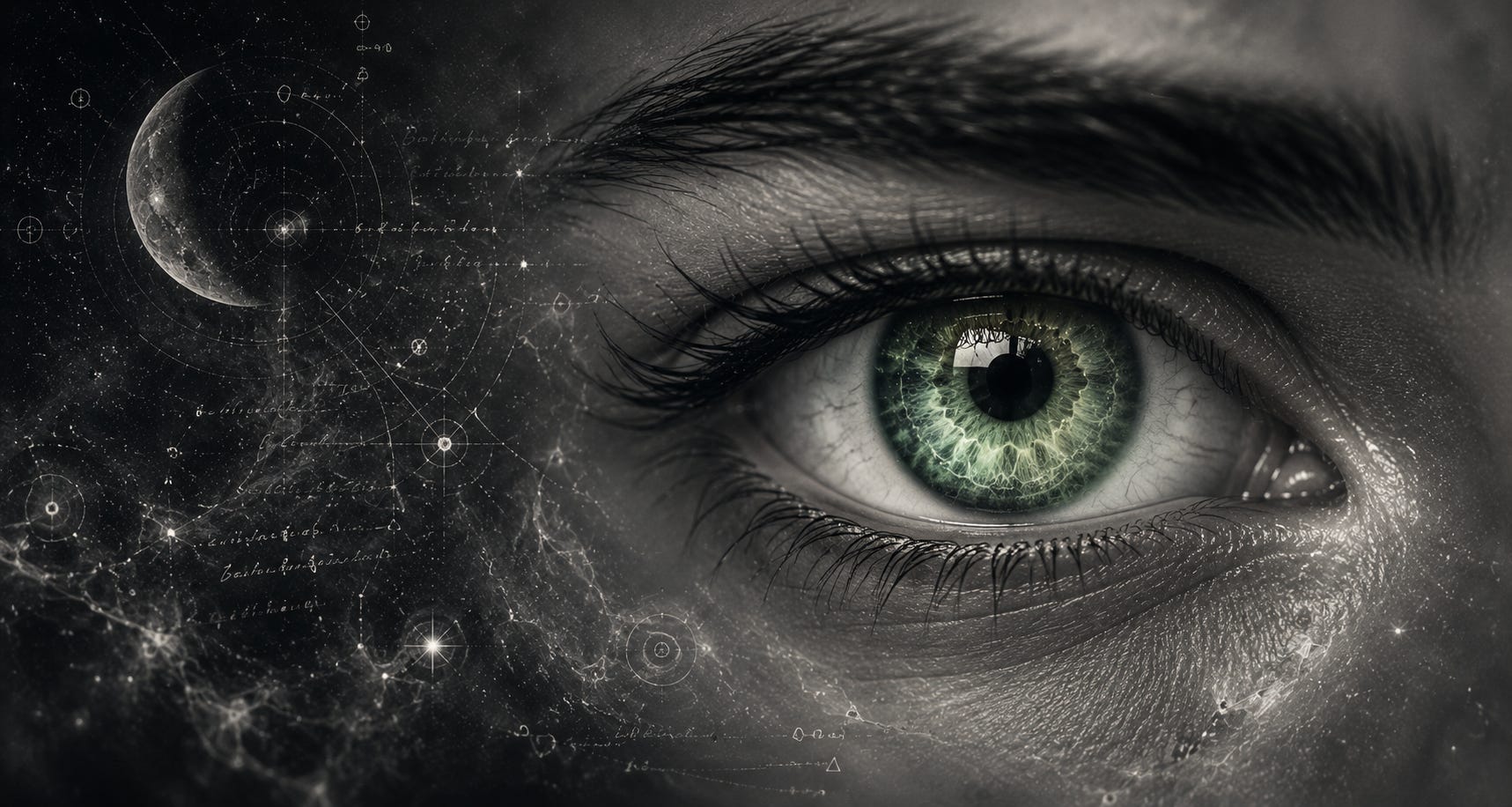
I’ve been down many rabbit holes inside myself as I write Centarficus; an exploration that begins not only in my biography, but in my biology, which includes the color of my eyes. I have green eyes. Only about two percent of the global human population does.
What is that about?
To understand why green eyes, exist at all, you have to understand that they are, in the most precise scientific sense, an accident of calibration. Eye color is the product of a cascade of at least sixteen different genes orchestrating how much melanin the iris produces, where it is deposited, and how light moves through it.
The two primary conductors of this orchestra sit side by side on chromosome 15: OCA2 and HERC2.
The OCA2 gene produces what scientists call the P protein, which governs the maturation of melanosomes, the cellular structures responsible for producing and storing melanin. The HERC2 gene sits beside it like a volume dial, containing a segment of DNA in its intron 86 that switches OCA2 expression on or off.
When HERC2 turns OCA2 down, melanin production decreases. Too much melanin gives you brown. Too little gives you blue. Green requires something else entirely: a narrow, almost improbable middle ground where low-to-moderate melanin combines with a phenomenon called Rayleigh scattering, where light refracts off the iris’s structure to produce the color you actually see. It is less pigment and more physics.
To arrive at green, the genomic configuration has to be precise. Not just at OCA2 and HERC2, but across the supporting cast of additional genes: ASIP, IRF4, SLC24A4, SLC45A2, TPCN2, TYR, TYRP1, each contributing to the final frequency of the light leaving my iris.
And even with all those variables trending in the right direction, it doesn’t always produce green. Prediction models for intermediate eye colors succeed at only about 73% accuracy, compared to 94% for predicting blue or brown. Green is the system’s most ambiguous output. Its most uncertain creation.
Adding another layer: green eyes are not static. They shift with light, with mood, with the colors worn close to the face. Because the hue is partially structural, produced by the interaction of melanin and scattered light rather than by pigmentation alone, they are inherently reactive to their environment. My eyes have been called hazel in winter and emerald in summer. I have looked in mirrors under certain fluorescent lights and seen something almost gray, and sometimes blue.
This shape-shifting quality is not cosmetic. It is physics expressing itself through biological architecture that has no exact equivalent in anyone else on earth.
Approximately 79% of the world carries brown eyes. Blue eyes appear in roughly 8–10% of the population. Hazel sits around 5%. Green? About 2% globally, and that number skews heavily toward specific geographies.
The highest concentrations appear in Ireland, Scotland, and parts of Scandinavia, where some regional estimates reach as high as 30%. More than 75% of green-eyed people worldwide can be traced to Ireland and Scotland. There is evidence of green eyes in Siberian populations dating back to the Bronze Age, approximately 4,000 years ago. There are green-eyed communities in Liqian, China, theorized to descend from Roman soldiers who traveled east centuries ago.
Green eyes leave traces in history because they were so uncommon, they were impossible to ignore.
If the intersection of genetics and human history is something you want to unravel further - Fingerprints of the Gods by Graham Hancock pulls it hard and doesn’t let it go.
Here is where the science gets stranger and more interesting.
Edinburgh University psychologist Dr. Anthony Fallone has studied the neurological connections between the eye and the brain, and his observation cuts to the center of something: the eye is so closely linked neurologically to the brain that you might call it the only part of our brain you can see from the outside.
This is not metaphor. The optic nerve is a direct extension of the central nervous system. The retina is, developmentally, brain tissue that migrated outward. When you look into someone’s eyes, you are, in the most literal sense, looking at their brain.
Perhaps this is why the eyes go black when the brain dies? I muse.
Emerging research has begun to suggest that the genes governing melanin production, specifically OCA2 and HERC2, also influence neurodevelopmental processes in the frontal lobes. The same genes that calibrate the melanin in my iris may also be calibrating dopaminergic activity in my cortical circuits.
This means that green eyes may not merely be a correlate of certain neurological patterns. They may be a visible marker of the same genetic configuration that shapes those patterns from inside the brain.
The same genome that built my eyes built my nervous system. They are not separate stories. And understanding how the nervous system stores and processes what it receives, including what it receives beyond ordinary sensory channels, is some of the most important science being done right now.
A study of 428 subjects conducted at Örebro University in Sweden found that distinct personality patterns emerge across eye colors, with the traits clustering in ways that corresponded to the genetic pathways involved. Green-eyed individuals were found to carry an unusual combination, dominant and agreeable like brown-eyed people, yet cautious and internally strong like blue-eyed people.
Ophthalmologist Dr. Hamadi Kallel describes green-eyed people as possessing an air of mystery and a quiet self-sufficiency, often unpredictable, but slow to anger, and capable of performing with clarity under pressure. Where did this concept come from? Before science had language for any of this, cultures around the world were already tracking something similar.
In ancient Greece, green eyes were associated with sea gods, beings whose nature was ungovernable, and who could nurture or destroy. Green eyes were linked to the goddess Athena, patron of wisdom and cunning. In ancient Egypt, green was the color of Isis, of magic, of life itself. The Eye of Horus amulet, worn as protection against illness and evil, was most often carved from green stone.
The Celts believed green eyes indicated faerie blood, a direct biological inheritance from the otherworldly. Celtic lore held that such people existed in two worlds simultaneously: the visible one and the one underneath it. Norse mythology gave Loki green eyes. Across West Africa, green-eyed individuals were believed to read omens, detect lies, and see the future. According to certain Native American traditions, green-eyed people can perceive both the physical world and the spiritual realm at once.
Then Christianity swept through Europe, and everything previously revered became suspect. During the witchcraft hysteria of the 16th and 17th centuries, green eyes became a diagnostic feature, a visible sign of demonic alliance. The same trait that once marked divine favor now marked someone for burning.
I am a survivor. I understand, intimately, what it means to be marked as wrong for something that is simply part of what you are.
What strikes me about this history is not the superstition, but the consistency. Across cultures that had no contact with each other, across centuries, across continents, green eyes kept pointing toward the same cluster of associations: perception beyond the ordinary, access to what is hidden, movement between worlds. I don’t think that’s coincidence. I think ancient people were observing something real and encoding it in the only language they had.
For those who want to go deeper into the history of persecution, witchcraft, and the women who were marked and burned for what they simply were, The Witch’s Book of the Dead is a compelling read. As is Witch: Unleashed, Untamed, Unapologetic by Lisa Lister; for the women reclaiming what was taken.
Telepathy: What the Research Actually Says
The word telepathy was coined in 1882 by Frederic Myers, a founding member of the Society for Psychical Research, to describe the transmission of thoughts or impressions from one mind to another without the use of recognized sensory channels. For most of the century that followed, the scientific establishment treated it as folklore.
Then the research started accumulating.
Meta-analyses of Ganzfeld studies, a technique using mild sensory deprivation to quiet mental noise, have produced what researchers describe as compelling evidence for the existence of telepathic phenomena. A 2008 fMRI study examined a known mentalist during the performance of a telepathic task and found significant activation of the right Para hippocampal gyrus, a region associated with pattern recognition, memory, and the processing of environmental context, following successful telepathic performance.
The U.S. government agreed it was worth studying. For decades, classified research under programs like STAR GATE and SCANATE investigated remote viewing. When the research was eventually declassified and reviewed by UC Davis statistics professor Jessica Utts, she concluded that using the standards applied to any other area of science, the case for psychic functioning has been scientifically proven.
The Stargate Chronicles by Joseph McMoneagle - written by one of the U.S. Army’s most documented remote viewers, goes inside that research from the perspective of someone who lived it. DMT: The Spirit Molecule by Rick Strassman approaches the same territory from the neurochemical side, what happens in the brain when consciousness expands beyond ordinary perception.
I have had too many moments of knowing, before the phone rang, before the door opened, and distant conversations sensed and heard in whispers, too many to dismiss. And over the last decade of study and research, I find myself asking: is this connected to what I am, genetically? To the particular configuration of DNA that produced these eyes?
Not Feeling Like We Belong Here
There is one more point here I want to chew on, and it is the most personal to me.
Green-eyed people appear in a disproportionate number of conversations about feeling alien. Not metaphorically alien (as in extraterrestrial), but existentially alien. The sensation that everyone else was given a manual for being human that somehow didn’t arrive with you. The sense of watching the world from slightly outside it, of processing experiences at a frequency that doesn’t match the ambient noise.
I have felt this my entire life. The research on highly sensitive people, those who process sensory and emotional information more deeply than average, documents this experience extensively. The Highly Sensitive Person by Elaine Aron was one of the first books that made me feel seen in the specific texture of this particular alienation. Not broken or too much. Just differently calibrated.
What I keep returning to is the question of whether the genetic architecture that produces green eyes might also be producing a nervous system calibrated to receive more signal than the average person can comfortably process. A nervous system that registers more nuance, more emotion, and more of what is simmering underneath the surface of things, would feel like being too much. It would look like intensity to others. It would produce the exact profile that green-eyed people are described as having across multiple independent studies: creative, perceptive, quietly self-sufficient, slow to anger, capable under pressure, and perpetually a little out of place.
The color in my eyes is the product of a rare collision of genetic variables. What if the neurology those same genes built is similarly calibrated toward something outside the common range? What if we don’t feel like we belong here because we are, quite literally, a different genetic expression? Not better. Not worse. Just different.
The Living Instrument
I don’t have any pure conclusion to offer. Science is still mapping the relationship between pigmentation genes and neurological function. Parapsychology is still accumulating evidence that is statistically significant but not yet institutionally accepted. The history of green eyes in global culture is rich and consistent, but it is story, lore, not proof of anything significant, from my personal perspective.
What I have is this: I exist inside a body that carries a rare genetic signature. The same genes involved in producing my eye color appear to influence the architecture of my brain’s frontal lobes. The eye itself is neurologically contiguous with the brain, the only part of the central nervous system visible from outside the body.
I’ve spent years trying to understand why I receive the world the way I do, beyond trauma, into genetics, why some signals come so acutely, why I feel things I haven’t been told, and why belonging has always felt like a language I can almost, but not quite, speak.
The genetics won’t give me a final answer. The mythology won’t either. But together they point toward something I think is worth considering curiously: that our particular bodies, with our particular eyes, may be wired to perceive in ways that most people aren’t.
The rarest eye color in the world. The rarest kind of knowing?
I’m not sure those are separate facts. What if our eye color and knowing are interlinked?
If the topics in this article rattled anything loose in your thinking like they did mine, or if you have always felt the signals around you come in differently, more acutely, and from places that don’t have viable identities, these are the reads I’d put in your hands:
Paranormal Nonfiction Reads - for the ones who know something else is out there and want the documented evidence.
Spirit & Afterlife Books - for the ones whose knowing extends beyond the physical.
Energy & Empath Reads - for the ones whose nervous system receives more than most people can see.
If this resonated, come check out my other Substack publications. That’s where the conversation continues.
— Vennie
©️ Centarficus | Centarficus.com
Centarficus © 2015 by Vennie Kocsis is licensed under CC BY-NC-ND 4.0
currently using → this diffuser
currently wearing → this shirt
As an Amazon Associate, I earn from qualifying purchases. All recommendations are my own.
Read the previous post:
The Nephilim Are Among Us

The quote came to me like most disruptive ideas do, between other meandering thoughts and contemplations that then insist on being explored: