
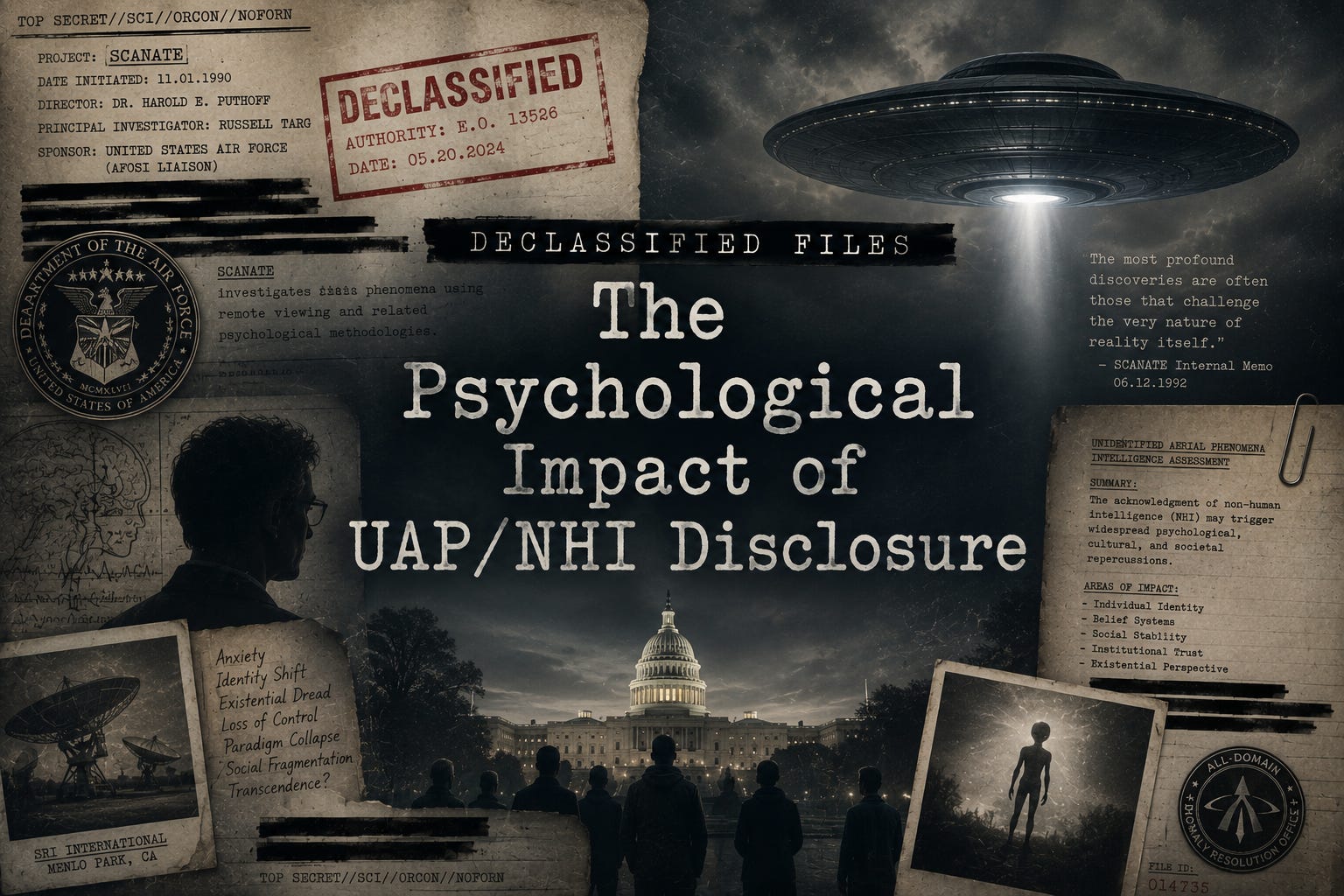
In June of 2026, six psychologists published seventy-one pages about what happens to human beings when the government finally says all the quiet things about UAP/NHI out loud.
I read the whole thing with open objectivity and curiosity. What surprised me most wasn’t the doomsday modeling, though that’s in there. It was how much of the paper touches on the damage that has already happened to experiencers. Decades of ridicule built a population of people who experienced the anomalous and told no one; only twenty-six percent of experiencers have ever disclosed. The paper treats that form of forced silence as an injury.
Below is my summary of what’s in the paper. The full white paper is available for download at the end of this summary, and I encourage you to read it yourself, since this is my own condensation of its contents, and should not be a substitute of its full depth.
The core argument
Disclosure is already happening, and nobody has planned for what it does to people.
The paper’s starting point is a February 19, 2026, presidential directive ordering federal agencies to begin releasing classified records on UAP and possible non-human intelligence. The authors’ claim is not that this will cause a crisis, but that no U.S. or international public health authority has formally addressed the psychological aspects at all, and that absence is itself an unaddressed vulnerability in national preparedness.
They’re explicit about two limits on their own work: they have no access to classified material, and governments themselves may not have complete answers. So, the framework is deliberately scenario-agnostic; built to hold up whether NHI turn out to be benevolent, indifferent, or hostile.
The thesis that runs through all five sections: public response will not be determined by the information disclosed, but by the psychological and cultural conditions the information drops in. Communication quality, institutional trust, and existing resilience do more work than the information itself.
Section I: Defining the event
The paper anchors its terms in statute rather than culture. UAP is defined per the UAP Disclosure Act of 2023 and NDAA FY2022 (including submerged and trans-medium phenomena). NHI is defined per NDAA FY2025 as any intelligent entity not originating from human civilization, deliberately silent on origin, substrate, or dimensionality, which keeps extraterrestrial, interdimensional, and ultraterrestrial hypotheses all on the table. Disclosure covers both controlled government release and uncontrolled release by ex-officials, other governments, or third parties; the authors note uncontrolled disclosure may carry equal or greater psychological impact.
They then build a five-stage model:
Limited: phenomena acknowledged as real but unexplained. The U.S. has arguably been here since the 2017 New York Times piece; a dozen-plus countries have done the same with no measurable social disruption.
Confirmatory: official and scientific consensus that some phenomena aren’t human technology. No government has crossed this line.
Attribution: officially acknowledged association with known non-human intelligence.
Reconciliation: the broader body of knowledge becomes public: what has occurred, what was known, what was withheld.
Full Integrated: disclosure stops being an event and becomes an ongoing societal condition.
The stages are planning scaffolding. Crucially, the authors argue response at one stage can’t be used to forecast response at the next, and the calm public reaction to Limited Disclosure proves nothing about Attribution. And they flag Reconciliation as potentially the most psychologically consequential stage of all, because the impact there comes as much from the realization of concealment as from the content.
Section II: The psychological landscape
Historical precedent. Copernicus and Galileo, Darwin, continental drift, quasicrystals, adult neurogenesis; humans do integrate paradigm-breaking information, but slowly. Adult neurogenesis took roughly 36 years to be accepted, quasicrystals 29. Disclosure could compress a generational process into months, creating a mismatch between the pace of disruption and the pace of adaptation.
The concealment problem. Drawing on the Pentagon Papers, the Church Committee, and Snowden, the paper introduces institutional betrayal, measurable psychological harm from trusted institutions violating expectations of honesty. Since disclosure may involve admitting decades of concealment, the authors argue institutional betrayal could become a defining psychological dimension of the event itself, not a side effect. They extend this to science: 91% of U.S. scientists report self-censoring empirical beliefs.
What the UAP research actually shows. This is one of the strongest passages. De la Torre’s 2024 study of 93 direct witnesses found no significant difference from the general population on sleep, memory, attention, personality, or overall functioning. What he found instead he calls the UAP Deep Psychological Engagement Triad: persistent preoccupation, intense interest, and ongoing need to discuss, transformative but focused on the phenomenon, not generalized dysfunction.
Stubbings et al. found only 26% of witnesses disclosed anywhere and 14% used formal channels; Ryan Graves testified fewer than 5% of military sightings were reported. Rabeyron found that among those seeking clinical help, the barrier was rarely the experience, but the fear of pathologization and clinician unfamiliarity. Four out of five Dutch practitioners felt unprepared to treat anomalous experiences; the IGPP in Freiburg reported ~80% of help-seekers located their distress in the aftermath (isolation, disbelief, fear of psychiatric labeling) rather than the experience.
The implication the authors draw: distress here is largely socially manufactured, not inherent.
Processes activated. Uncertainty as the primary trigger, with intolerance of uncertainty treated as a population-scale variable rather than a clinical niche (a study of 86,000+ found 60% in medium-high or high categories). Cognitive dissonance resolving through assimilation, accommodation, or rejection, with population-level polarization as the aggregate result. Confirmation bias, biased assimilation, and the third-person effect (people assume others will panic; institutional reluctance to disclose may rest on this bias rather than evidence). Neurocognitive constraints, inattentional blindness, predictive processing, and the free-energy principle, suggesting some difficulty integrating anomalous information is architectural, not motivated. Threats to ontological security. Meaning making. Cognitive load and triage.
Two anchors cut against panic assumptions: a 2021 Pew survey found 87% of U.S. adults saw UAP as no threat or a minor one, and existing belief is already widespread; up to 75% of Americans believe life exists elsewhere, ~50% believe aliens have visited, and 41% believe some UAP are craft. Peters’ religious survey found 83–94% across traditions said confirmation wouldn’t undermine their faith. For most people, this is a shift in understanding, not a departure from it.
Section III: Mediating factors
Communication, institutional trust, and resilience. The authors note the 1953 CIA-sponsored Robertson Panel already concluded the real risk was rumor, anxiety, and misinformation rather than the objects themselves.
Best practices: communicate early, acknowledge uncertainty, use percentage framing, coordinate across agencies, plain language, trusted messengers, predictable schedule, and transparency.
Failure modes: delay, contradiction, overconfidence-then-revision, politicized framing, one-way communication, and notably, labeling alternative hypotheses as conspiracy theories, which the authors argue drove people toward less reliable sources during the COVID lab-leak debate.
The sharpest formulation in the paper is a three-line distinction: “We do not yet know X” invites patience. “We will never know X” invites adjustment. “We are not telling you X” invites distrust. Managed ambiguity, not uncertainty, is the destabilizing factor.
The trust environment is bleak: 40% of Americans trust the federal government at all, 23% think it’s transparent, and 27% think it listens. Trust can’t be manufactured at the moment of disclosure, it’s rooted in infrastructure, not in tactic.
On resilience, they lean on Masten’s “ordinary magic” and the Blitz-spirit example: preparedness can’t create resilience at scale, only avoid disrupting what already exists.
Section IV: The response spectrum
Six regions on a continuum, not fixed categories: positive engagement and curiosity; neutral compartmentalization; interpretive resistance and identity framing; anxiety and intolerance of uncertainty; vulnerability activation in predisposed individuals; and catastrophic framing.
The key reframe: this is a surge-capacity problem, not a mass-panic problem.
Roughly 23.1% of U.S. adults experience mental illness annually. The UK’s Unhidden Foundation modeled high-risk groups at ~35% of the adult population, projecting 1.9–5.7 million UK adults needing support and NHS demand rising 37–110% above baseline within weeks. Even a small activation rate across a very large population produces operationally significant demand, a version of the prevention paradox. Lomas’s analysis of ~5,000 posts after the July 2023 congressional hearing found ontological fracturing rather than ontological shock: partial, heterogeneous disruption, with reflective and positive engagement among the most common responses.
At the far tail, “catastrophic disclosure” (Col. Karl Nell’s term for disclosure that is challenging, unpredictable, uncontrolled, and fast) could be read through apocalyptic frameworks, with ~49 million U.S. evangelicals reporting end-times belief, even a small fraction is hundreds of thousands of people. The authors also flag possible financial-market panic as a black-swan secondary shock, and the risk of high-control groups and cults absorbing people seeking certainty.
Children absorb adult emotional tone more than information; adolescents fold it into identity formation and peer networks. Culturally, many non-Western and Indigenous cosmologies already accommodate non-human intelligences, so the disruption gap depends on distance between what’s disclosed and what was already thinkable.
Section V: Recommendations
A National Psychological Preparedness and Resilience Task Force, multidisciplinary, with six priorities: public/behavioral health coordination; scalable mental health surge capacity (telehealth, group models, emergency interstate licensing beyond PSYPACT); clinical training to close the response gap; public psychoeducation; community-based support through schools, workplaces, and religious organizations; and crisis intervention systems including 988.
On communication: cross-agency coordination, WHO-style crisis frameworks, real-time information-environment monitoring (explicitly framed as monitoring system strain, not belief), audience-specific materials, media engagement to replace ridicule-based framing, and support for meaning-making, on the grounds that humans are story processors rather than information processors.
Ethics: avoid premature pathologization; preserve transparency; protect psychological autonomy (which “begins with access”, people can’t engage authentically with information they aren’t given); equity of access; professional competence.
Research gaps: population-level and longitudinal studies, surge-capacity modeling, witness mental health, cross-cultural comparison, message testing, and clinical curricula. They identify the Department of War’s PURSUE archive of sequential timestamped releases as a naturalistic experiment already running.
Closing position
Humanity has integrated worldview-breaking information repeatedly; there’s little reason to think this exceeds our capacity. What matters is integrity in the telling, people cope better with difficult truths than with prolonged uncertainty, contradiction, and perceived deception. Preparation is framed as both practical and moral: a minority already living with mental illness, trauma, isolation, or rigid identity-linked belief will bear the impact and safeguarding them is the measure of the response.
Notes on the paper’s overall form
The evidence base is honestly hedged. Most conclusions come from adjacent literatures, COVID, disaster mental health, risk communication, because UAP-specific research barely exists, which the authors attribute to the same stigma they’re analyzing. The paper says so directly rather than papering over it.
Its analysis covers Limited, Confirmatory, and Attribution stages only. It explicitly declines to model Reconciliation and Full Integrated disclosure.
The most quotable throughline is that stigma is treated as a structural variable rather than a social attitude, something that shaped what could be studied, who reported, and what clinical expertise exists today.
The full white paper is below.
Download: The Psychological Impact of UAP/NHI Disclosure — The Disclosure Foundation, June 2026

August 2026. Personal Notes.
What I Kept Looking For
If you’ve come back after reading the paper, thank you. If you haven’t downloaded it yet and you’re just reading on, that’s fine too. This part isn’t the paper, though. It’s the thoughts I had while I read it.
I want to say first that I’m glad this paper exists. Six people with credentials to protect sat down and wrote seventy-one pages about the inner lives of experiencers. That’s a marker, and something that hasn’t been done before.
The first question came to me while I read the five stages. Limited, Confirmatory, Attribution, Reconciliation, and Full Integrated. Every one of them moves in the same direction, toward the phenomena being real, toward it being confirmed as non-human, off world, and toward it becoming ordinary. I kept waiting for the other angle to be considered. What happens if the files open and the answer is there was never anything there at all. Instead, we find PSYOPS, classified aerospace, sensor errors, secret programs dedicated to private investments, and operations creating the very thing it claims not to be able to identify?
That’s a possible outcome. It might be the likeliest one. And it has its very own aftermath, which nobody has planned for either. Skeptics get vindicated. Witnesses get a second helping of the ridicule that made them quiet the first time. A paper this careful about what stigma has already cost people should have modeled the scenario where disclosure makes the stigma worse, and the implications of disclosing seventy+ years of citizens, including children, being victims of psychological warfare and operations.
The paper isn’t completely silent on deception. It has a whole framework for it. Institutional betrayal, harm that comes not from what was done, but from finding out you were kept in the dark about it. Pentagon Papers. The Church Committee. Snowden. The authors say that concealment may become one of the defining psychological dimensions of the whole event, and I think they’re right.
What’s missing is the details and the why. Concealment sits in that section as a kind of thunderstorm, something that happened and damaged trust. There’s no mention of proprietary technology, of contractors, or of anyone having reparations in the outcome. If part of what disclosure eventually reveals is that governments lied solely to protect financial investments, that isn’t the same psychological event as lying for national security or lying out of paternalism. It’s going to have a very different effect on a person. It should have been considered as its own scenario. This also has a profound effect on experiencers, and, for the sake of the paper’s goal, the general population as a whole.
Another thing I keep circling back to is the paper says Reconciliation Disclosure, the stage where what was withheld becomes the story, may carry more psychological, social, and political consequence than confirmation of non-human intelligence itself. Then in Section V it excludes Reconciliation from the analysis. They point at the most dangerous room in the house and then close the door. without processing the contents.
The third question I had was about who’s supposed to actually catch us and hold the keys to the solutions.
The recommendations are for a federal task force. HHS. CDC. NIH. NIMH. Coordinated messaging across agencies, monitoring of the information environment, trusted messengers, and unified framing.
I read all of that and thought: if Reconciliation reveals that these institutions participated in decades of deception, they are not neutral responders. You’re asking them to provide solutions for what they created.
The paper never says this. It builds an entire response architecture and hands it to the same structures whose credibility the event would destroy, without once noting that conflict. I know first-hand the consequences that occur when the people managing the harm are also the people charged with protecting and serving you. I don’t need to explain to this audience why that arrangement doesn’t work.
The fourth thing I looked for was accountability, and there isn’t any.
Section V has five ethical principles. Don’t pathologize prematurely. Be transparent. Protect autonomy. Provide equal access. Be competent. All good. All forward-facing.
Nothing about the people already harmed. Pilots who lost credibility. Officers who were quietly reassigned. Civilians who told one person and never told anyone again. The paper says only twenty-six percent of witnesses have ever disclosed anywhere, and fourteen percent used a formal channel, and it treats that as a data problem, an underreported evidence base. While that is true, it is also a record of what was purposefully taken from people. Reducing stigma going forward is not the same as answering for it. Accountability is one of the biggest steps to reducing stigma. There is no provision for this necessary open accountability of behavior from the governmental entities as part of the reducing stigma solution.
And the last one. There is no experiencer voice among the six authors.
The community partners listed for support are psychological associations, schools, workplaces, and religious organizations. No experiencer-led groups or singular experiencer participants.
So, the paper is a careful, well-sourced, genuinely humane document about a population that was studied, but not offered a seat at the table. It says the most reliable finding in the whole literature is that we are psychologically ordinary: no elevated pathology, no fantasy proneness, and functioning fine. It says the damage came from the denial and silence around us, not from what we experience.
If both of those things are true, and I think they are, then there was no reason not to ask us to participate in an important conversation, that is about us.
I’m not writing this to take the paper apart. I’ll be citing it for years, and I want it read. But when a document about experiencers is published, the useful thing an experiencer can do is not only share it, but also say where it missed for us, with the hope that whoever writes the next one will consider our input and expand the study.
"We do not yet know" invites patience. "We will never know" invites adjustment. "We are not telling you" invites distrust. That three-line distinction might be the single most useful tool in either the paper or your response to it, since it correctly isolates the actual variable doing the psychological damage. It was never uncertainty itself. Genuine not-knowing is something humans tolerate remarkably well, historically, repeatedly. What destabilizes people is the specific, detectable sensation of a gap between what's being said and what's actually known, which reads as betrayal regardless of the content eventually revealed.