
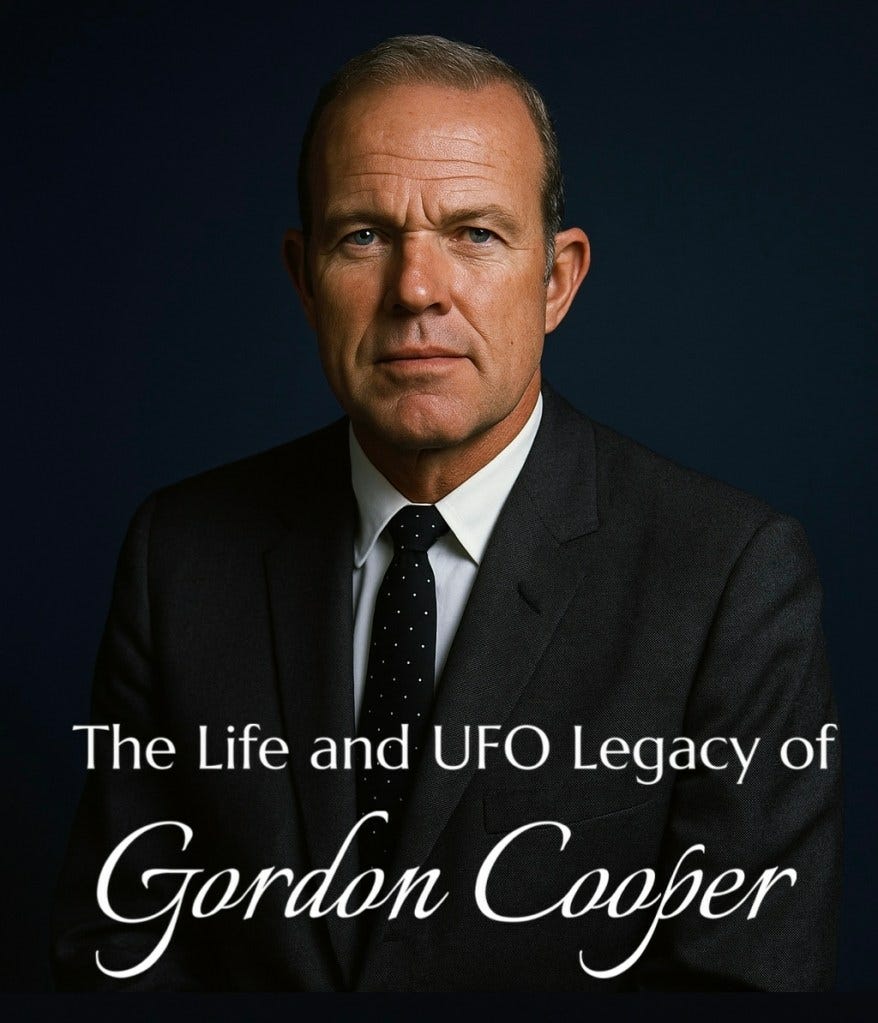
In the pantheon of American astronauts, few names evoke such a powerful mix of national pride and cosmic mystery as that of Leroy Gordon “Gordo” Cooper Jr.
He was one of the original Mercury Seven; a band of fearless pilots hand-picked in 1959 to push the United States beyond Earth’s gravity and into the space race. But while Cooper’s reputation as a test pilot and spacefarer secured him a place in NASA’s official history books, it’s his unflinching testimony about unidentified flying objects that continues to ignite debate more than fifty years later.
For many, Cooper is remembered as a hero in a silver suit, one of the last true test pilots whose steely nerve carried him solo around the Earth 22 times in Faith 7. But to those who’ve followed the shadowy corridors of the UFO phenomenon, Cooper is equally the astronaut who broke ranks with official silence; an insider who spoke of otherworldly craft, official cover-ups, and what he believed was an undeniable truth: that we are not alone.
Leroy Gordon Cooper Jr. was born on March 6, 1927, in Shawnee, Oklahoma. He grew up under vast Midwestern skies, the only child of parents who encouraged his early fascination with flight and engineering. His father, Leroy Sr., was a World War I veteran and an aviation enthusiast himself, who often took young Gordon up for rides in open-cockpit planes.
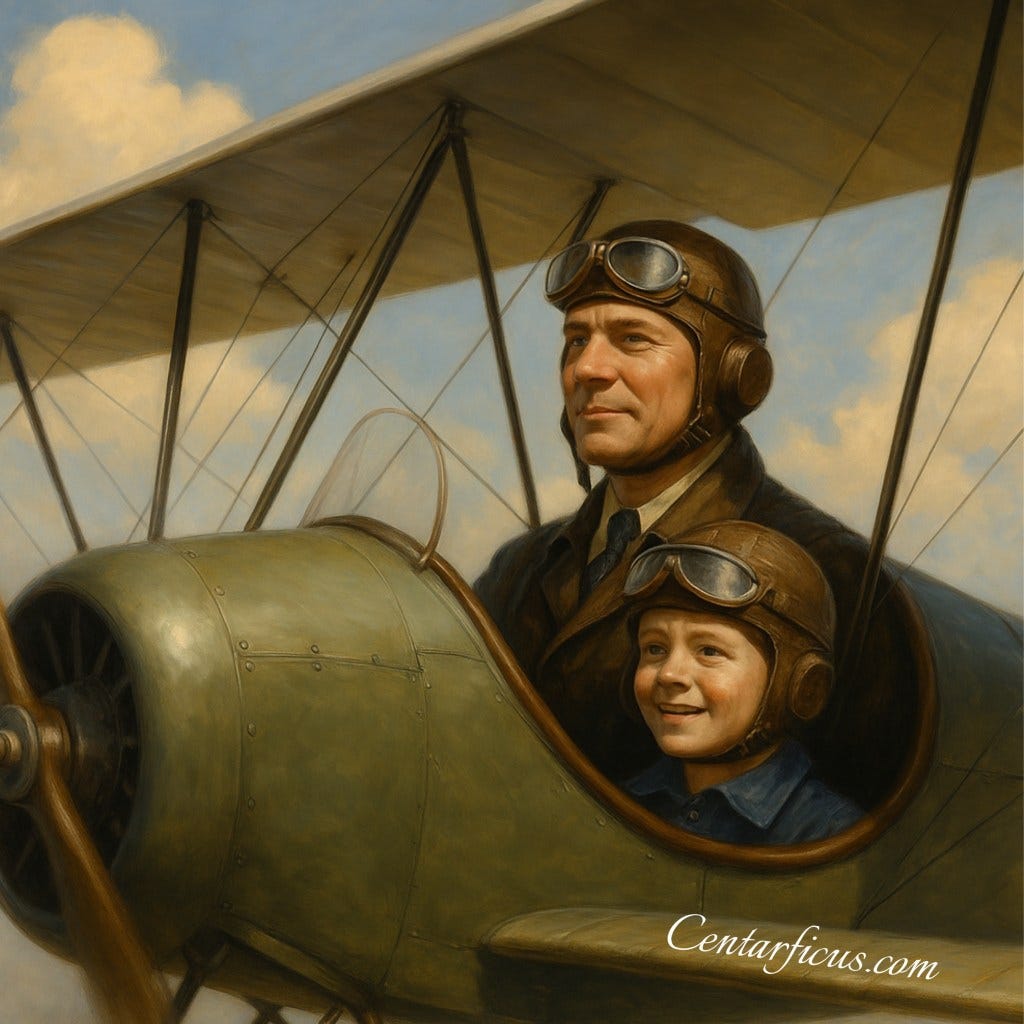
By the time he was seven, Gordon had already learned the basics of flying. He built model airplanes, dreamed of fighter jets, and spent his days studying how things worked, from engines to wings to the shimmering trails left by high-flying aircraft.
After high school, Cooper joined the U.S. Marine Corps during World War II but the war ended before he could see combat. He later transferred to the U.S. Army and then the Air Force, where he earned his pilot’s wings and graduated from the prestigious Air Force Institute of Technology. By the early 1950s, Cooper was stationed in Germany, flying F-84 Thunderjets and F-86 Sabres at the height of the Cold War. He quickly distinguished himself as a precise, cool-headed pilot who could push the limits of both speed and altitude.
The Mercury Years: Into Orbit
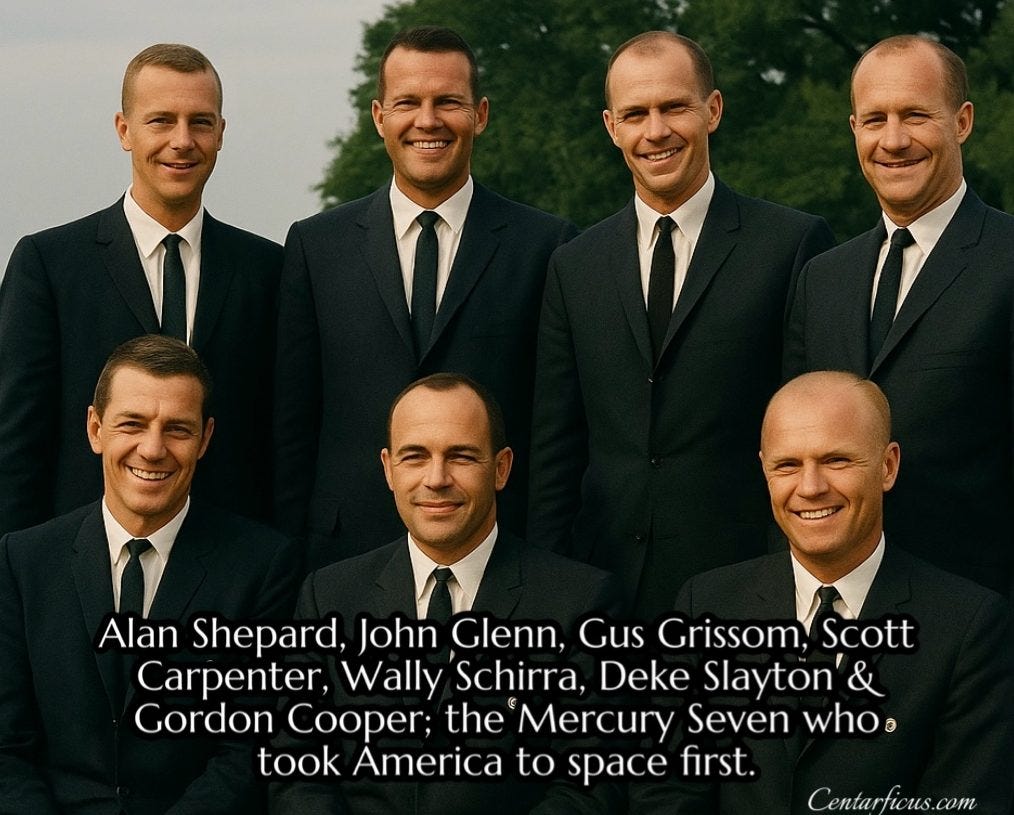
In 1959, when NASA announced Project Mercury, Cooper was among 110 military test pilots who volunteered for what was, at the time, one of the most dangerous jobs on Earth; or above it. After grueling physical and psychological tests, only seven men were chosen: Alan Shepard, John Glenn, Gus Grissom, Scott Carpenter, Wally Schirra, Deke Slayton, and Cooper.
On May 15, 1963, Cooper made history aboard Faith 7, becoming the last American to fly solo in space. Over 34 hours, he orbited Earth 22 times, proving that humans could survive, work, and adapt in the unforgiving vacuum of space for extended periods. He famously took manual control when an electrical problem arose, navigating his capsule home with the skill of a pilot more comfortable at the stick than behind a computer.
His Mercury mission sealed his reputation as one of NASA’s steadiest hands. He later commanded the Gemini 5 mission alongside Pete Conrad, setting a new space endurance record and laying the groundwork for the Apollo missions to come.
Beyond the Capsule: A Secret Kept in the Skies
Yet it was what Cooper saw, and what he said, outside the cockpit that cemented his legend among UFO researchers. While still a test pilot at Edwards Air Force Base in the mid-1950s, Cooper was supervising a team building a new landing field when an event occurred that would haunt him for the rest of his life.
In broad daylight, Cooper’s crew spotted a saucer-shaped craft silently hovering over the dry lake bed. The craft extended landing gear and gently settled on the desert floor. The cameramen Cooper had assigned to the site caught it all on film. Before Cooper could reach the site, the craft lifted off vertically and disappeared into the sky at astonishing speed.
Cooper immediately sent the footage to his superiors in Washington. The film, he later claimed, vanished into government vaults; never to be seen again. “They did not want this story to come out,” he told interviewers years later. “They were afraid of a panic, or they just didn’t want the public to know we weren’t in full control of the skies.”
It wasn’t the first or last time Cooper reported seeing unexplained craft. As a fighter pilot in Europe, he witnessed mysterious lights that defied conventional explanation. Unlike many of his peers, he refused to brush them off as atmospheric illusions or misidentified enemy aircraft.
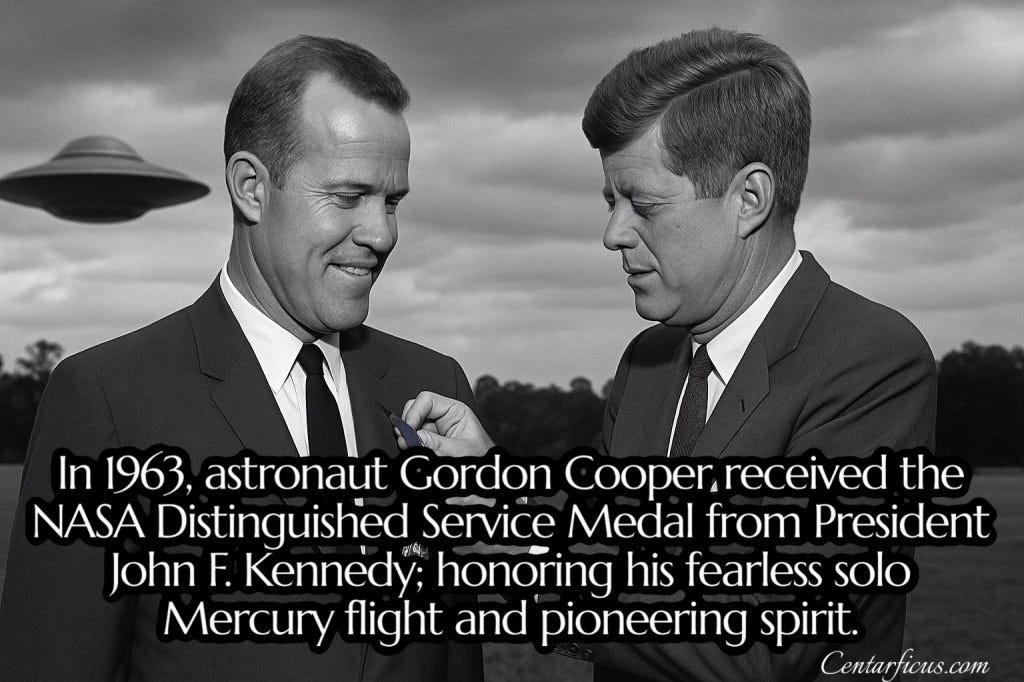
On May 21, 1963, just days after his triumphant return to Earth, astronaut Gordon Cooper stood in the White House Rose Garden as President John F. Kennedy pinned the NASA Distinguished Service Medal to his lapel. The honor came in recognition of Cooper’s extraordinary Faith 7 mission; America’s final solo Mercury flight.
For Kennedy, the moment was more than ceremonial; it was symbolic of a young nation’s bold promise to lead in space exploration, with men like Cooper embodying the bravery and ingenuity needed to fulfill his famous pledge to reach the Moon. Cooper, ever the cool-headed pilot, accepted the award with the same quiet confidence that had guided him through electrical malfunctions and manual reentry; a living testament to the American spirit in the Space Age’s earliest, most uncertain days.
An Astronaut’s Quiet Defiance
When asked about UFOs later in life, Cooper never flinched. He testified before the United Nations in 1985, declaring that “intelligent beings from other planets” had been visiting Earth for centuries and that global governments knew more than they were admitting.
“I believe that these extraterrestrial vehicles and their crews are visiting this planet from other planets,” Cooper wrote in a signed letter read before the UN Special Political Committee. “I feel that we need to have a top-level, coordinated program to collect and analyze scientifically all available data on every kind of encounter, and to determine how best to interface with these visitors in a friendly fashion.”
His statements were remarkable not only for their content but for who they came from; a decorated astronaut and military pilot with everything to lose and nothing to gain by sticking his neck out for flying saucers. To this day, his testimony is cited by UFO researchers as one of the strongest endorsements of the phenomenon’s reality.
A Legacy: A Pilot, A Pioneer, A Watcher of the Skies
Gordon Cooper died in 2004, but his legend has only grown in the decades since. To some, he remains the quintessential American test pilot: fearless, innovative, unyielding in his pursuit of the unknown. To others, he’s a whistleblower whose plainspoken words helped keep the UFO conversation alive through decades of denial.
In life, Cooper balanced the calculated logic of a military engineer with a childlike wonder about what might exist beyond our atmosphere. His courage wasn’t limited to the flames of a rocket launch or the delicate maneuvering of orbital flight. It extended to his willingness to ask the questions that many in government and science preferred to keep buried; questions about who we are, what flies above us, and whether the sky really is the limit.
In the annals of NASA, Cooper’s name is etched alongside Mercury and Gemini hardware, high-altitude test flights, and cold war heroics. But somewhere, in a dusty archive or a locked vault, maybe there still sits a reel of 16mm film; proof that one of humanity’s greatest sky farers saw something unearthly touch down in the desert sun.
If Gordon Cooper’s life reminds us of anything, it’s this: no matter how high we fly, there are always mysteries waiting to greet us in the thin air above, and perhaps far, far beyond.
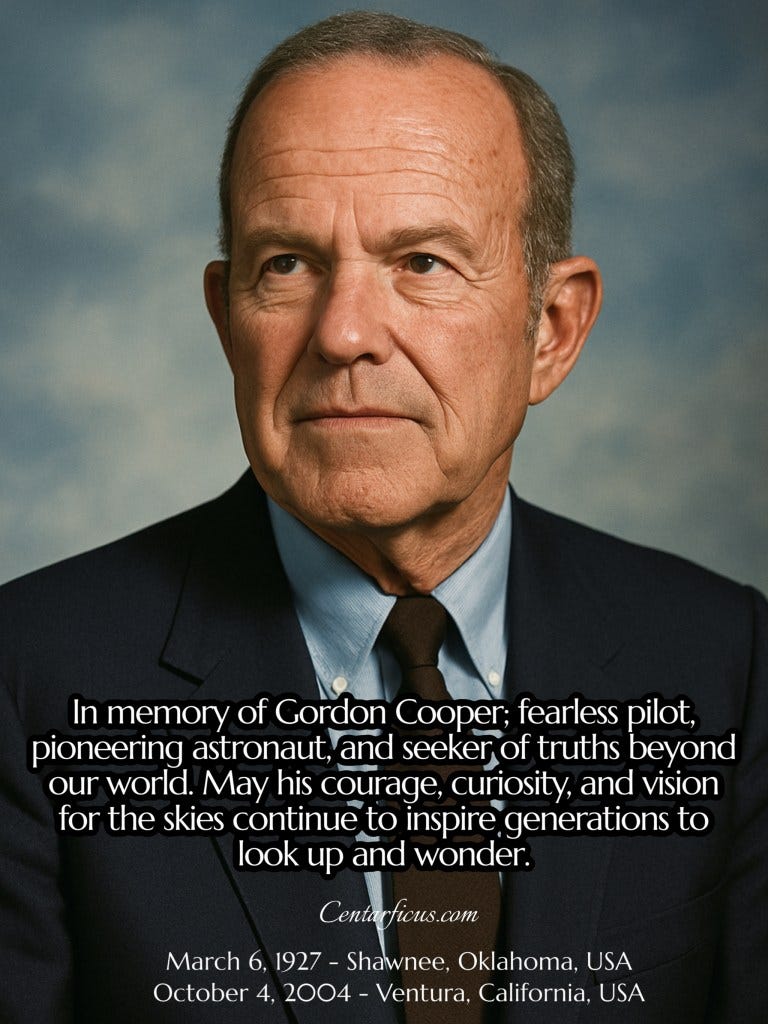
©️ Centarficus | Centarficus.com
Centarficus © 2015 by Vennie Kocsis is licensed under CC BY-NC-ND 4.0
Books by Gordon Cooper
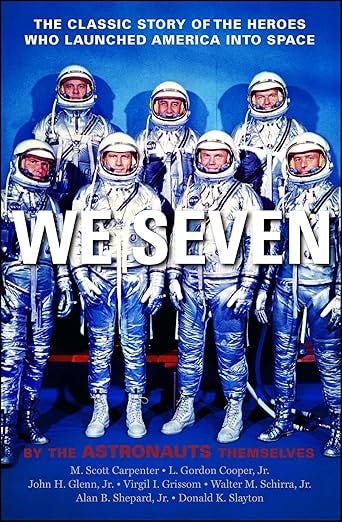
In “We Seven”, first published in 1962, the astronauts including Scott Carpenter, Gordon Cooper, John Glenn, Virgil Grissom, Walter Schirra, Alan Shepard, and Donald Slayton, take you behind the scenes of this pioneering program, even into the space capsules themselves.
Featuring fascinating firsthand accounts and black-and-white photographs throughout; the astronauts describe the exhilarating launches, hair-raising challenges, and incredible successes of Project Mercury, from breaking through the earth’s atmosphere to panicking when a hatch blows.
by L Gordon Cooper Jr (Author), Loudon Wainwright (Author), John H Glenn Jr (Author)
Additional Authors Are Donald K. Slayton, Virgil Grissom, Walter Schirra, Jr., Scott Carpenter, And Alan Shepard, Jr. The Only First Hand Story Of America’s Man In Space Project, By The Seven Astronauts Of Project Mercury.
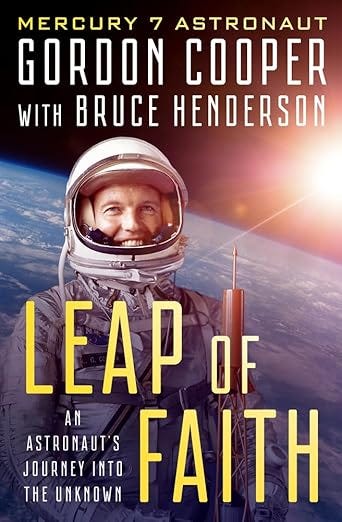
In his remarkable memoir Leap of Faith, written with #1 New York Times bestseller Bruce Henderson, Cooper recounts crossing paths with aviation legends like Amelia Earhart, Wiley Post, and Wernher von Braun, relives his test pilot years at Edwards Air Force Base that inspired The Right Stuff, and offers a candid look inside NASA—sharing honest reflections on triumphs, setbacks, and the heroism of his fellow astronauts. He also confronts the mysteries that haunted him most: his steadfast belief in extraterrestrial life and the U.S. military’s decades-long UFO cover-ups. With Cooper at the helm, Leap of Faith invites readers on a breathtaking journey few have ever experienced.
Interviews with Gordon Cooper
Gordon Cooper 1999 Interview on UFO Sightings in 50s
Former Mercury Astronaut Gordon Cooper interview about UFO landing
Astronaut Gordon Cooper Talks About UFOs
Gordon Cooper’s Finest Hour (1963)
Gordon Cooper Phone Calls Collection on Letterman, 1984, 1989 (Edited)
Dennis Quaid & Gordon Cooper “The Right Stuff” 1983
Gordon Cooper Receives Astronauts Medal (1963)